Fuji Team Issue Build

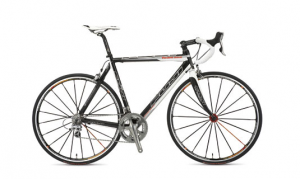
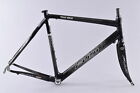
At the same time that I got the Miyata 210 frame, I purchased a Fuji Team Issue frame with a front fork.  The frame and fork were carbon fiber and had been listed as being repaired.  Since the seller was a bike shop with a very good rating, I crossed my fingers and hoped it would be ok.  From the pictures nothing seemed to be wrong with it.  And when I received it, everything was fine.  This is the frame that I intend to use as the basis for a bike that I would ride in the neighborhood with my family.  Here is a picture of the frame from the eBay listing and a picture of a complete 2008 model.
This build is a nod to the Fuji Finest that I liked back in the 70s.  This build turned out pretty well.
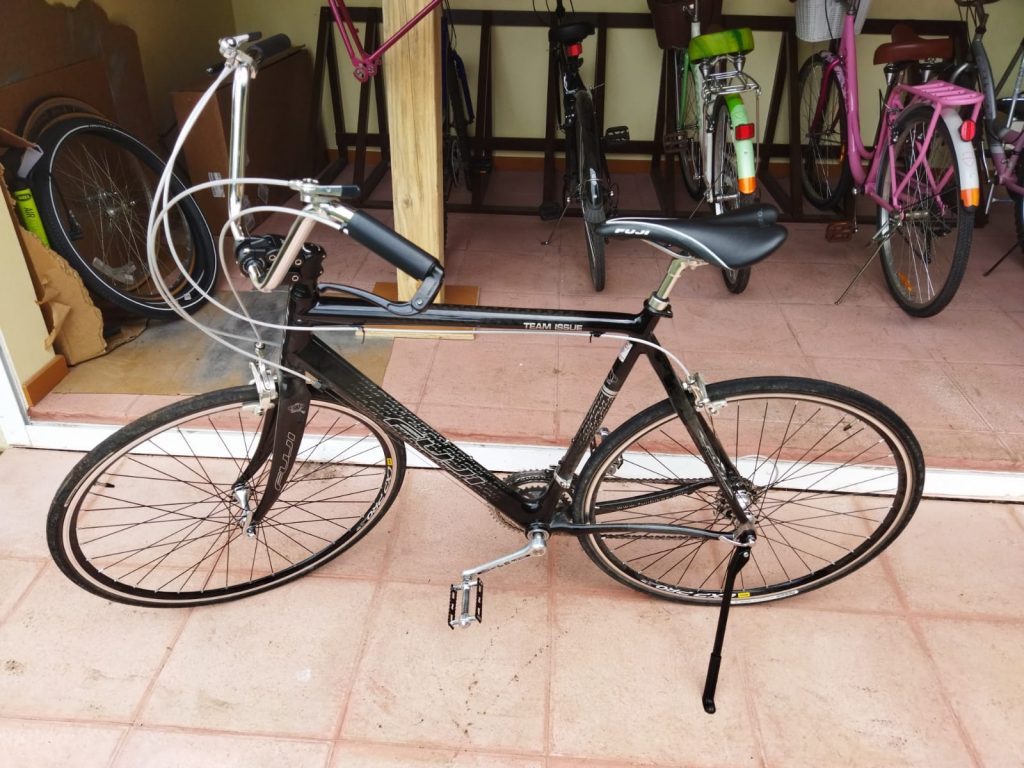
While I still intend on adding the toe clips and straps that I have on hand, the build is pretty much completed.  I didn’t do a build using original components.  I mixed and matched components that I thought would work well.  One component that I didn’t go with, was standard drop handlebars.  This was due to the negative effect that bending down while gripping them would have on my lower back.  So I opted to use Wald 870 high rise handlebars which would allow me to sit fairly upright.  I paired up some Dia-Compe DC188 brake levers (with matching handle grips) along side the Wald 870 handlebar.  Topping that off that setup with an IRD Power Ratchet Thumb Shifter set.  I included a number of Campagnolo components in the build.  The front and rear brakes are Campagnolo Centaur Dual Pivot Caliper brakes.  The front and rear derailleurs are Campagnolo Racing T derailleurs.  Both of the wheels were built using Campagnolo hubs with Mavic CXP Pro 15mm rims.  The tires are 700-28c Panarace Gravel Kings.  I used Velo Orange Cable sets for the brakes and derailleurs.  The saddle is a Fuji Velo which is on a generic compression seat tube.  The seat tube along with a 90mm Cirrus Cycles Suspension Stem dampens the bumps a bit.  The bottom bracket is an IRD QB-55 (127.5mm x 68mm) with English Threads.  The crankset is a triple from a Fuji S10S (most likely from the 80s).  I used a pair of MKS Sylvan Touring (Black and Silver) pedals.  To finish off the bike I used a kickstand that attached to the bike using the quick release on the rear wheel.  The frame, saddle, and crankset all say Fuji on them.

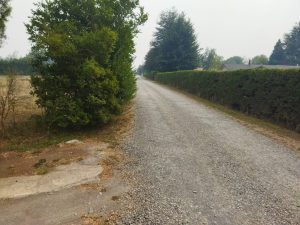
I will be exclusively riding around the roads in my neighborhood.  I don’t intended to ride the bike on the open roads.  It is too bad the roads in my neighborhood aren’t paved, but it is what it is.
73 degrees by 73 degrees

A bicycle geometry of 73 degrees by 73 degrees back in the late 60s and early 70s, could be found on racing bicycles of that era.  But that geometry was entirely appropriate for light (or even medium-load) touring bikes too.  The Fuji S10-S was introduced in 1971 in the US market at the start of the 70’s bike boom.  My introduction to Japanese bicycles was earlier that that.  Back in the late 50’s my family owned a few bicycles that were purchased when we lived in Japan.  The bicycles went with us when we moved back to the US, but eventually they were gotten rid of when we moved again.

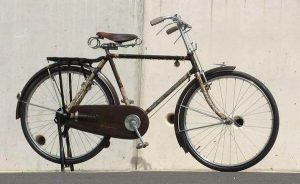
While this is not a picture of one of the bicycles that my family owned, it does have the same characteristics that I remember.  Namely the brakes with metal rods instead of metal cables, the kickstand that lifted the rear wheel, the big chain guard, and the seat with springs.  If I find one of the pictures of the bikes we had, then I will add it.

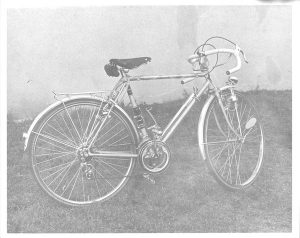
The first bicycle that I owned was a Miyata Sunrise Sport.  My brother originally purchased the bike in 1967 when we were living in Japan again.  After a few years the bike basically became mine in the spring of 1969.  Here is a picture of the Miyata Sunrise Sport.  A friend of my father called it a Fussa Cadillac.  Fussa was the city that we lived near in Japan.

I rode that bike around for a number of years and fixed things on it as needed.  In the Fall of 1974 I had a well read copy of the Consumers Reports for Bicycles.  There were quite a few bicycles that I liked.  The Fuji Finest was one them.  It was one of Fuji’s road racer models, second to the Fuji Professional.  It was a ten speed and came in two colors, rainbow blue and white.  The Fuji Finest is a great example of the classic Japanese racing bike in the traditional European style.  In 1974, Fuji was ranked first in the Consumers Reports bicycle test.

The Gitane Interclub was another bicycle that I was interested in.  The Fuji Finest was a bit more expensive than the Gitane Interclub.  The Interclub along with the Gran Sport DeLuxe were the bottom level models that Gitane offered during the early 1970s.  Back in September 1975, I purchased a used Gitane Interclub (24″ model) for $100 from a guy who worked at the Proteus bike shop in College Park Maryland.  I was a freshman at the University of Maryland at the time and I rode that bike around the campus a lot that year.  I still had the Interclub back in 2007 but got rid of it when we moved from Georgia.  Side note:  The Proteus Bike Shop used to have a class on frame building.  I never got to sign up for the class since I couldn’t afford it.  The book they have for frame building is available on line as a pdf.  They long since stopped offering that class.

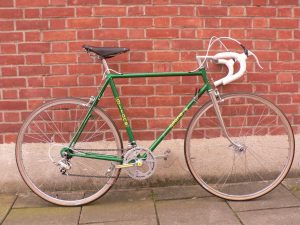
While this is not a picture of the Gitane Interclub I had, it is just like it.  With the green color and chrome front forks.  Later on I painted the frame purple.  Despite using a spray can, it turned out pretty well.

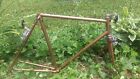
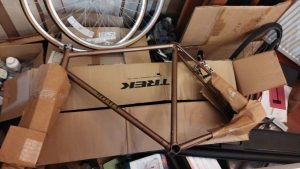
Earlier this year I was looking for a bike that I could ride around the neighborhood with my children.  I hadn’t really found anything that I liked at the bicycle stores, so I started collecting parts on eBay to build a bicycle for myself.  The first thing that caught my attention was the frame for a Miyata 210.  I was partial to Miyatas since I had fond memories of the Sunrise Sport that I had.  Besides, Miyatas were good bikes and made well.  Unfortunately it needed a bottom bracket and a lot of other things.  It is definitely a project bike.  I went ahead and purchased the frame.  I also purchased the two wheels that were originally on it.  We will see how it goes from here.