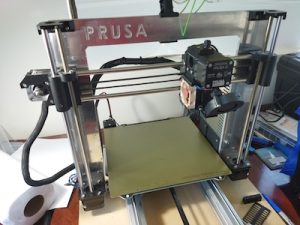
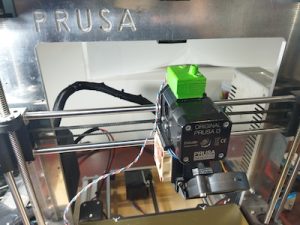
Finally finished building my Prusa MK3x

This build wasn’t a straight up kit so I ran into issues. Here are some of those issues that occurred after building my Prusa MK3x.  From Prusa I had gotten all the steppers, the sensors, and various other parts.  The frame pieces I got from Aliexpress.  The controler board I got from Ultimaker, but it is the one that Prusa also uses. So this is sort of a Frankenstein build.  This build has been in the making for quite a few years.  I should have just gotten a complete kit from Prusa and built that.

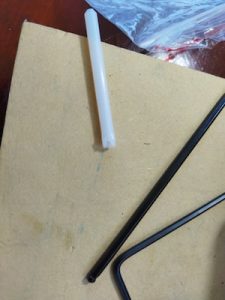
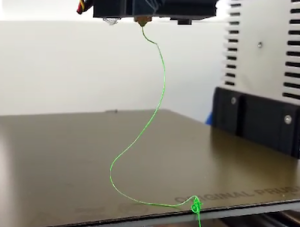
Over the years Prusa has upgraded its MK3 printer line with the latest iteration being the MK3S+.  After I finished the build I plugged it in and tried out the calibrations.  While the stepper motors were functioning correctly, things weren’t working.  The filament sensor didn’t seem to work.  The wiring was correct, but it didn’t know if the filament was loaded or not.  The printer kept going through its bed leveling routine before doing a print.  So I had to turn off the filament sensor to continue.  Another issue was that the extruder was not working.  The stepper motor was turning, but no filament was extruding.  The firmware does make you heat up the bed and the hotend before you attempt to do so.  It seemed that filament didn’t go all the way to the hot end for some reason.  So I took apart the hot end and I saw that the PTFE tube in the heatsink was deformed at the opening.  I had another piece so I replaced it.

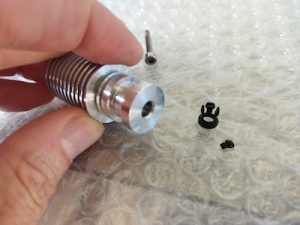
I reinstalled all the pieces and tried again.  While I was able to insert the filament a little bit more, I still couldn’t extrude any filament.  So I took apart the hotend again.  I looked into the hotend and there was a little bit of plastic blocking the inside of the tube.  The plastic bit had broken off of the retainer clip for the PTFE tube that fit into the heat sink.  Not sure how that happened, but I replaced it.

After I reassembled the extruder, I tried again to extrude some filament and I was successful!

But I needed to check the tension on the gears in the extruder.  There might be too much tension.  I checked the tension on the belts and adjusted them to be with in the stated tolerances.  I used the online app that Prusa had on their website to test the harmonics of the belts after you pluck them.  It seems to work after a fashion.

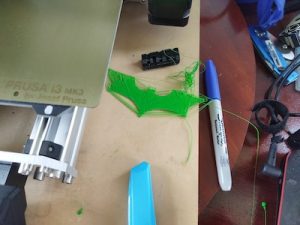
I did a few test prints and I see that I still need to do some more adjustments to my prints up to par.   One thing is that the bed surface probably should have been cleaned, but I just wanted to see if I could even print.  Remember I said that the filament sensor didn’t see to work, I had to turn off the filament sensor in the settings to even get a print to start.  Part of the printing process the printer does a bed leveling check and goes over like 9 different points on the heatbed taking measurements.  Well after it did the check, it wanted me to unload the filament and then load it back in again.  It went to do the test again.  And after it finished the second time, it again wanted the filament to be unloaded/loaded.  I did that again for a third time before I thought I would turn off the filament sensor in the settings.  After that I was able to start printing.  They weren’t very good prints but it was trying.  But it is a work in progress!  Need to make more adjustments.

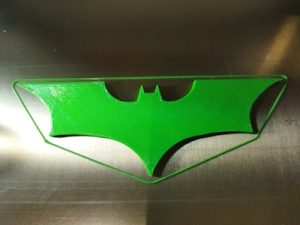
My z offset set  apparently is still too high.  So I need to lower it.  After trying a few different Z offsets, I was able to set the Z offset to -0.850mm and get a good first layer.  After that I was able to get a nice print of the Batman logo.

The feeding of the filament just didn’t seem correct also.  I believed that this was throwing things off.  Since the extruder setup I have on the printer is a MK3/MK2.5 type, there were two allen screws that needed to be adjusted.  Looking at the prusa site, it said that the top of the allen screw heads should be flush with the hole the went in.  Previously I had each around 8 full turns in.  I made it flush like the Prusa guide noted.  Then I started over with the first layer test.

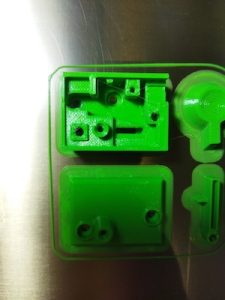
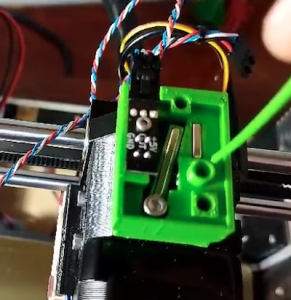
I decided to use an IR filament sensor instead of older type I initially installed.  So one last thing I did was to print out a Bondtech IR filament sensor housing adapter that I found online.  Due to the parts I have, the older non IR filament sensor fits my extruder housing, but not the newer IR filament sensor.  While the print turned out great, I had to order a newer IR filament sensor since the rev I had was 1.1 and only rev 1.4 or above works with the firmware.


Until next time.  Happy Printing!

Update on my Miyata 310 Build

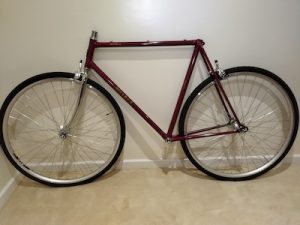
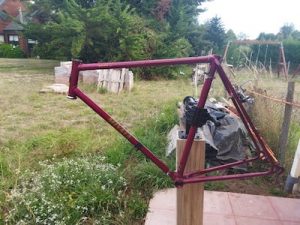
It has been a long time since I last made a post.  More than a year.  Much too long.  I pretty much have gathered all the parts I needed for the Miyata 310 build.  In my post talking about bicycle tires, I was trying to see how large of a tire I could use.  While I thought that I had enough clearance to use a 700-38c tire, it turned out to be not the case.  There just wasn’t enough clearance for the rear tire in the frame.  So I went with a 700-35c tire.  Here is a partial frame build with 700-35c tires.  You can see that I have enough clearance with the rear tire.  I will be cutting the top of fork to size later.

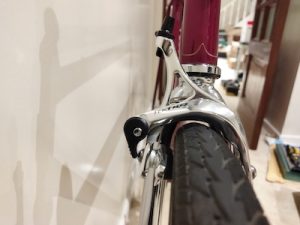
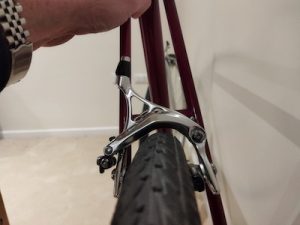
Here are pictures showing the front and rear brake clearances.  On the front I am using a Tektro R540 brake and on the rear I am using a Tektro R539 brake.  I had a Tektro R539 on the front, but the brake arm was pressing right on the tire and you couldn’t turn the tire without rubbing it on the brake arm.  Switching to a Tektro R540 on the front gave me plenty of clearance.  The fork that I got for the frame, uses brakes with a  recessed nut.  While the rear brake uses the older nutted style.  I would have tried to use a Tektro R540 for the rear, but it doesn’t come in the old nutted style which the frame needs.

That’s it for now, catch you later.  Bicycle!

Dude, where’s my Tire?

Back when I had my Gitane Interclub it had 27″ wheels with tubular tires.  There were 700c wheels (ISO 622) around but I don’t think I was familiar with them at the time.  The 27″ wheels (ISO 630 mm) are often found on older road bikes like I had. The 27″ wheels are slightly larger than 700c at 630 mm as opposed to 622 mm.  Hence there is a 4cm difference on the brake reach.  On my old Miyata I don’t remember if the tires were 27″ or not.  I feel like they were 26″ tires.  I went to Western Auto to get replacement tires for it from time to time.

There are so many choices when it come to tires now days depending on the bicycle type (Touring, mountain, gravel, etc.).  There are 26″ (ISO 559)  tires which are used on mountain bicycles and cruisers.  There are 650b or 27.5″ (ISO 584) tires which are also used on mountain bicycles.  There are the 700c or 28″ (ISO 622) tires which I have mentioned already which are used for road, hybrid, city, and touring bicycles.  There are the 29″ tires which are used as a marketing term for wider 700c tires.  Then there are some less common tire sizes such as the 27″ (ISO 630).  While the 27″ (ISO 630) is less common now days, it is still widely available, but not usually bought on new bicycles.

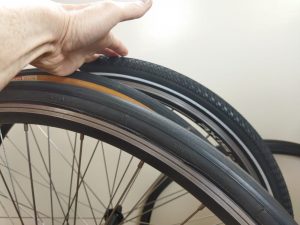
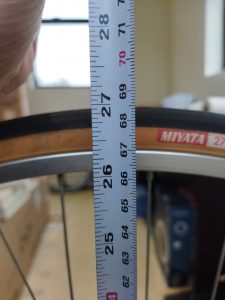
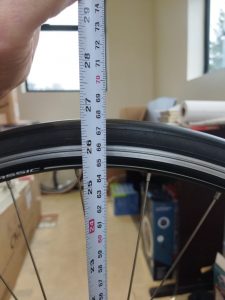
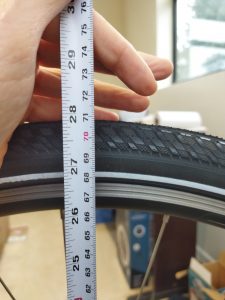
I have a set of 27″ wheels that I got with the Miyata 210 frame.  I will be using them with the Miyata 310 build.  But I am going to use 700c wheels as the primary wheels for the Miyata 310 build since I can use wider tires with the 700c wheels.  Here are some pictures that I took of the 27″ wheels along with two 700c wheels (both having the same type of rim).  The 27″ wheel happens to be almost 27″ tall.  The 700c with the 23c tire is about 1/2″ shorter at roughly 26.5″.  And the the 700c with 38c is roughly an 1″ taller at almost 28″.  There will be plenty of clearance for the wider and taller 700c tires on the Miyata.


My Miyata 210 310 build

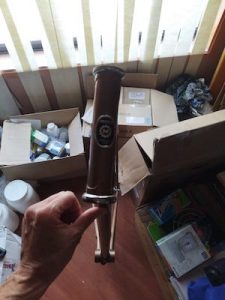
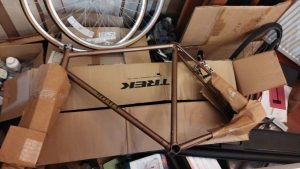
I intended to use a Miyata 210 frame that I got from eBay for a bike build/restoration.  My reason behind a Miyata build, was to pay homage to my first bicycle, a Miyata Sunrise Sport.  But things didn’t go well for my intended Miyata 210 build.  I have been using a freight forwarder in the Miami Florida area to send eBay purchases to me in Chile. When I received the frame in early September, I gave it a quick glance. There was some cardboard around front fork for shipping. But things had come up during that time and I did have the time to really look at the frame. So at the end of December I completely took the frame out of the box and remove the cardboard around the front fork.  There was some cardboard between the fork tips to keep them separated.  I also purchased the original wheels for the frame and started to put the wheels on the frame.  I put the rear wheel on and it seemed fine.  I put the front wheel on and something was seriously wrong.  The fork arms were bent!  I looked at the frame and discovered that not only were the fork arms bent, it seems the frame was bent at the head tube too.


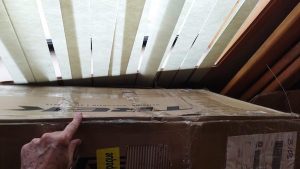
Looking at the packing box, it didn’t look like there was any damage to it.  But it kind of looked pushed in on one side.  But really not that bad.

The fork was installed in the frame and it was turned so the front of the arms were pointing backwards.  It seems that something fell on the front end of the frame where the fork is, causing the fork arms and head tube to bend.  From the original pictures of frame on eBay, everything looked fine.  Looking at the frame now, you can see areas on the fork and the head tube when the paint cracked from when the fork and head tube were bent.  Since it had been too long since I received the frame, I can’t really do anything about it.  I didn’t spend a lot for the frame, but still.  I did contact the freight forwarder but they said they could not do anything about it since I didn’t have it packed in a wooden crate (according to the fine print).  I did have them add extra bubble wrap, but that wasn’t good enough.  I really don’t know if it was damaged when it arrived in Miami or in Chile.  The freight forwarder doesn’t do a good enough job of noticing if items are damaged.  Their customer service was lacking too.  Plus they didn’t consolidate your packages either.  I have since changed to a new freight forwarder that has good customer service and consolidates packages.  Plus I can get insurance on my items shipped to me here in Chile.  So all around a better company.

Since I couldn’t use the frame or fork anymore, I went to eBay to see if I could find suitable replacements.  I was able to pick up a Miyata 310 frame, but it didn’t have a front fork.  So I picked up a front fork from eBay too.  It wasn’t from a Miyata, but it is new and fully chromed.  So it will be a nice touch.  This frame also happens to be a 1981 model like the 210 frame.  Both serial numbers start with the letter J which is for the year 1981.  After looking at the frame, I determined that it was ok.  Some minor scratches, but it is in good shape without any bends.

I removed all of the parts from the frame including the headset cups.  Next I will have to remove any stickers.  Can’t sandblast the stickers from the frame.  I also need to remove the Miyata head badge from the frame.

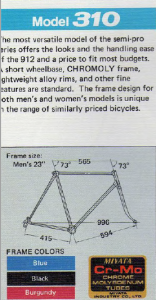
By the way, the 1981 Miyata 310 frames have that geometry of 73 degrees by 73 degrees that I mentioned in my last post.  The color of the frame is Burgundy which is one of the 3 colors available for the 310 in 1981. That’s it for now.


73 degrees by 73 degrees

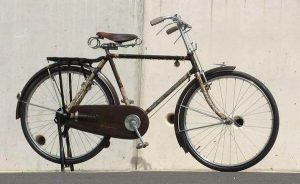
A bicycle geometry of 73 degrees by 73 degrees back in the late 60s and early 70s, could be found on racing bicycles of that era.  But that geometry was entirely appropriate for light (or even medium-load) touring bikes too.  The Fuji S10-S was introduced in 1971 in the US market at the start of the 70’s bike boom.  My introduction to Japanese bicycles was earlier that that.  Back in the late 50’s my family owned a few bicycles that were purchased when we lived in Japan.  The bicycles went with us when we moved back to the US, but eventually they were gotten rid of when we moved again.

While this is not a picture of one of the bicycles that my family owned, it does have the same characteristics that I remember.  Namely the brakes with metal rods instead of metal cables, the kickstand that lifted the rear wheel, the big chain guard, and the seat with springs.  If I find one of the pictures of the bikes we had, then I will add it.

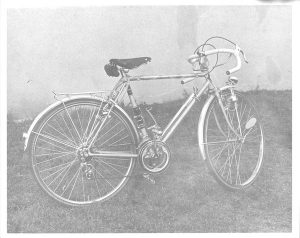
The first bicycle that I owned was a Miyata Sunrise Sport.  My brother originally purchased the bike in 1967 when we were living in Japan again.  After a few years the bike basically became mine in the spring of 1969.  Here is a picture of the Miyata Sunrise Sport.  A friend of my father called it a Fussa Cadillac.  Fussa was the city that we lived near in Japan.

I rode that bike around for a number of years and fixed things on it as needed.  In the Fall of 1974 I had a well read copy of the Consumers Reports for Bicycles.  There were quite a few bicycles that I liked.  The Fuji Finest was one them.  It was one of Fuji’s road racer models, second to the Fuji Professional.  It was a ten speed and came in two colors, rainbow blue and white.  The Fuji Finest is a great example of the classic Japanese racing bike in the traditional European style.  In 1974, Fuji was ranked first in the Consumers Reports bicycle test.

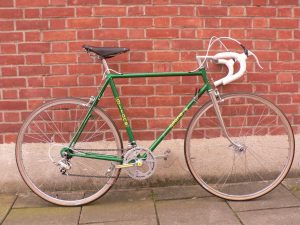
The Gitane Interclub was another bicycle that I was interested in.  The Fuji Finest was a bit more expensive than the Gitane Interclub.  The Interclub along with the Gran Sport DeLuxe were the bottom level models that Gitane offered during the early 1970s.  Back in September 1975, I purchased a used Gitane Interclub (24″ model) for $100 from a guy who worked at the Proteus bike shop in College Park Maryland.  I was a freshman at the University of Maryland at the time and I rode that bike around the campus a lot that year.  I still had the Interclub back in 2007 but got rid of it when we moved from Georgia.  Side note:  The Proteus Bike Shop used to have a class on frame building.  I never got to sign up for the class since I couldn’t afford it.  The book they have for frame building is available on line as a pdf.  They long since stopped offering that class.

While this is not a picture of the Gitane Interclub I had, it is just like it.  With the green color and chrome front forks.  Later on I painted the frame purple.  Despite using a spray can, it turned out pretty well.

Earlier this year I was looking for a bike that I could ride around the neighborhood with my children.  I hadn’t really found anything that I liked at the bicycle stores, so I started collecting parts on eBay to build a bicycle for myself.  The first thing that caught my attention was the frame for a Miyata 210.  I was partial to Miyatas since I had fond memories of the Sunrise Sport that I had.  Besides, Miyatas were good bikes and made well.  Unfortunately it needed a bottom bracket and a lot of other things.  It is definitely a project bike.  I went ahead and purchased the frame.  I also purchased the two wheels that were originally on it.  We will see how it goes from here.


Building a FreeNAS system

I finally decided to build the new NAS system I have been forever talking about.  I have been almost out of space on my ReadyNAS NV+ V2 for a while now. Going to go with FreeNAS and I am using Brian Moses’ 2019 EconoNAS Build as a guide.  My build won’t be quite an EconoNAS build.  I will call it the HexNAS due to the 5 data drives and the 1 cache drive that it will have.

I am using the same ASUS Prime B450M-A/CSM motherboard that he is using.  I am using 2 sticks of 16GB DDR4 Dram instead of the 2 sticks of 4GB DDR4 Dram he used.  So I have a total of 32GB of system memory with two empty memory slots.  I using an old Cooler Master case that was given to me by my friend Paul.  The case is very similar to the Antec NSK4100 case that Brian used.  My cases has 4 external 5.25” bays, 2 external 3.5” bays, and 5 internal 3.5” bays for a total of 11 drive bays.  So it has the same total number of drive bays just like Brian’s case.

I had to replace the case’s power switch which was missing its leads and was also bad.  The case didn’t have any fans, so I added 5 Noctua fans to it.  Two of the fans were 120mm and three of the fans were 140mm.  These Noctua fans aren’t their premium quiet fans.  But they are still quiet.


I am going to use a hot swap drive cage that will take up three of the external 5.25” bays and allow me to have five 3.5” drives in the same space.  I was thinking about installing a DVD drive in the fourth 5.25” bay.  But since I have used all of the 6 sata connections on the motherboard, I won’t be able to do that.  Not that I really need a DVD drive.  But if I do, then I can see about adding a card with sata connections.  I also added I/O panel with two USB 3.0 ports, SD card slot, and a USB C port to the case.

For the CPU I used an AMD Ryzen 3 3200G instead of the AMD Ryzen 3 2200G used in the EconoNAS Build.  For the power supply I am using a GameMax 650W 80Plus Bronze unit.  For the OS Drives I am also using SanDisk Ultra Fit Usb 3.1 flash drives, but 32GB instead of 16GB.

I had been thinking about using WD Red 4TB drives, but the newer units use SMR.  So with the issue of SMR rearing its ugly head I couldn’t do that.  Even the new WD 6TB Reds were using SMR.  Really need to use a drive using CMR especially since it seems that FreeNAS does not like SMR drives.

FreeNAS/ZFS does not like the new WD RED SMR drives.

Doing some research on the SMR issue, I found this link that with a list of the WD CMR and SMR drives.  List of WD CMR and SMR hard drives.

Here are some links to the SMR issue that I am talking about.

Surreptitiously Swapping SMR into Hard Drives Must end!

List of know SMR Drives.

I went ahead and bought 5 WD 8TB Red drives for the build.  These drives are CMR.  Brian has a few different hard drive options that he lists, but all of them are using 6 drives.  I am also adding a Crucial BX500 1TB SSD for use as a cache for the zfs pool.  I have those two Ultra Fit 32GB flash drives for the boot drives that I already mentioned.  Once the NAS is built and setup, I will look to sign up with get Blackblaze to add cloud storage/back-up to my NAS.  A NAS isn’t really for backup even though I have been using my ReadyNas NV+ V2 as such.

Here is a link that from Brian’s blog for backing up FreeNAS to Backblaze.  And here is a link to an article that Blackblaze wrote on setting up a FreeNAS cloud storage.  Along a similar vein, here is a link for setting up NextCloud on FreeNAS.

So far I have put together the system without the drives for now.  The system starts ok and goes into the bios.  It is working and I have 32GB of memory! Next I will have to download the latest version of FreeNAS which is currently 11.3-U4.  The FreeNAS iso is 752MB.  Now that I have the iso, I need to burn the iso on to a usb flash drive.  Since I am going to use my Win 10 laptop, I am going to use Rufus to create the bootable FreeNAS install flash drive.  Side note, after I did my install of FreeNAS I came across another install video that used a utility called HashTab that adds an extra tab in the Windows properties menu that will let you see the hash of the file.  A handy utility to have when you want to check if the hash of the file you just downloaded matches what it is suppose to be.  It is free for home use, but if you use it at work, then it is $9.99.

Next I will go to the HexNAS system and bootup the FreeNAS install.  I will be installing FreeNAS on the two SanDisk Ultra Fit Usb 3.1 flash drives.  I will be following one of Brian’s blog post on how to do the install onto the two flash drives.

I booted up the HexNAS with the FreeNAS install flash drive.  I tried to install FreeNAS to the two SanDisk Ultra Fit flash drives, but I kept getting an install error when the process started.  The error was installation failure – gmirror: No such device: swap.  I tried it a number of times more but still kept getting the error each time.  The two SanDisk Ultra Fit flash drives are brand new, so hopefully there is nothing wrong with them.  Did a quick look on line but didn’t really find an answer.  Maybe the flash drives need to be formatted.  What I did was use Rufus to install the FreeNAS install iso on to both of the new flash drives.  Booted up the original FreeNAS install usb drive and tried to install FreeNAS on both of the Ultra Fit flash drives and this time the install worked.  I guess it expected a swap partition to exist on the Ultra Fit flash drives. Not sure though.

While the install was suppose to write FreeNAS onto both of my flash drives, it didn’t seem to do that.  Not sure why, but I used a utility called imageUSB on Windows to save the image from the one bootable FreeNAS system on the flash drive to the my computer.  Then I used imageUSB to copy that image to the second flash drive.  You can also use imageUSB to write an image concurrently to multiple USB Flash Drives.

I successfully booted FreeNAS from that second flash drive.  Then I needed to make sure both devices were in the boot pool. I watched this youtube video and was able to have the boot pool contain both flash drives, so they are mirrored.

The instructions are for 11.2 but they work with 11.3 with a slight difference in the name “Boot Environments” in 11.2 becoming “Boot” in 11.3.  Here are the steps that I followed.  While in the FreeNAS dashboard, click on System to display the items inside of System.  Then click on Boot which will bring up the Boot Environments window.  From there you will Actions menu on the far right and then choose “Boot Pool Status”.  This will bring up the “Boot Pool Status” window.  You will see your default boot pool and if you click on the > next to name of the boot pool, you will se your boot flash drive in the pool.  Mine is /dev/dap0.  On the line that lists your boot flash drive you will need to click on the three dots on the far right of that line and choose “Attach”.  This will allow us to attach our other flash device to the first flash drive.  Select the second flash drive (da1) and check the box for “use all disk space” and press the “Save” button.  It will take a short while for the attach process to finish.  A popup window will let you know that the “Device Attached”.  Close that window.  You will be back in the “Boot Environments” screen.  Click on the “Actions” menu and choose “Boot Pool Status” again.  You will see that the two devices will both be under a “>mirror” selection which completes the task.  If you want to change the default name of the boot pool, you can do that in the “Boot Environments” window.  On the line that has the name of the boot pool, you will click on the three vertical dots on the far right.  This will bring up a menu with a choice to rename.  I renamed my boot pool to freenas-boot.  I need to put a little label on the flash drives so that I can easily identify them in a time of failure.  To identify the drives, it might be best to use at least the first 6 digits of the serial numbers since the numbers at the end aren’t displayed fully.

I have added the data disks and the ssd disk to the machine.  Next I will create the zfs pool.  The zfs options for the VDev are Stripe, Mirroring, Raid-z1, Raid-z2, and Raid-z3. Raid-z1 similar in concept to Raid-5.  But Raid-z1 use is discouraged. Raid-z2 is similar to Raid-6.  It adds a second set of parity data to the VDev.  You can lose two disks while maintaining data integrity.  It requires a minimum of 4 disks.  It is safer than Raid-z1 but has a greater capacity penalty. Raid-z3 adds a third set of parity data to the VDev.  It requires a minimum of 5 disks, but allows you to lose up to 3 disks per VDev.  A hot spare is a drive that isn’t used for storage, but it will instead immediately replace a failed drive. Having a hot spare in the pool will insure that a resilver/rebuild operation will start immediately.  When you are creating your pool, the ADD SPARE button will add a hot spare to your pool.

I am going to go with a Raid-z2 setup which will allow me to lose two disks while maintaining the integrity of the data.  I will be looking into getting Backblaze for my cloud backup.

Logged on to the FreeNAS machine via the web interface so I can create my zfs pool with the 5 drives and the one ssd for the cache.

It is pretty easy to do. Go to Storage->Pools and select the drives for the Data VDev.  I am using Raid-z2 for the Data VDev.  Add the SSD to the Cache VDev. Give the pool a name. Choose to use Encryption or not Zfs Pool.  The GELI encryption can increase security for data stored in a ZFS pool, but it increases pool management complexity.  If you select encryption you must remember to back up the key!  If you lose the key, then you will lose all the data on the disks with no chance of recovery!  I am not going to chose encryption.  Anything that is really important I will encrypt before I put it on the FreeNAS.  I also heard that in the next major FreeNAS version, TrueNAS core, they will likely have new encryption features like per dataset encryption which should make it possible to encrypt data with having to destroy/rebuild the pool.

Update: July 2022, TrueNAS has been out for a while and I did upgrade to it when it came out.  I still haven’t looked into the dataset encryption.  I will put that in another blog post one day.

It didn’t take long to build my pool with the 5 data disks and the 1 cache disk.  Next I will configure users, permissions, and Access Control Lists (ACL) for the users that will access the FreeNAS share that I will be creating.  The first user I will create will be my user.  While creating my user, I will create a group for all the other future users that will be accessing the FreeNAS.  I created the group while adding my user.  In the FreeNAS web interface menu, the path will be Accounts->Users and then click on the Add on the right side.  My username and password will be the same as it is for my Windows 10 laptop.

Now I have to create some shares.  The first thing I need to do is add a few datasets to my ZFS pool.  Go to Storage->Pools on the menu and then on the line that lists your Pool, click on the three dots on the far right to bring up the options for the pool.

I will be adding a dataset to the pool.  I will give the dataset a name, something like Media.  Make sure that the Share Type is SMB since it is going to be a Windows share.  I also will make sure that the Case Sensitivity is Sensitive.  You can add comments if you like.

Once that is done, I will create the actual Share.  Selecting Sharing->Windows Shares (SMB) on the menu will bring up the Samba (SMB) shares list.  Click on the ADD button to add a share.  Set the path to the dataset that you just created.  The dataset will be under your ZFS Pool location.  It will be something like /mnt/ZFSDataPool/Media which ZFSDataPool being the name of your ZFS Pool and Media being a dataset that you created in your pool.  There is a selection box for Use as home share, but I am not going to be selecting that. The selection boxes that are checked will be Enabled and Enable Shadow copies.  What you enter for the name of the Share will be what you will see when you access from your Windows computer.  The Share name can be different from the dataset name that it is attached to.  You will want to make sure that the SMB service has started and will automatically start when the system boot up.  You will be prompted to do so.  But you can go to Services on the menu and start up the service and also check the Start Automatically box for the Service.

After you have create the SMB share, you will want to edit the ACL for the share you just created.  On the SMB share list, you want to put your cursor on the line for the share you just created.  Then click on the three dots on the right to bring up the options for the share and select Edit ACL.

Here in the Edit ACL window, you will be adding an ACL Item.  You can add a group or user.  If you have a a lot of users assigned to a group, then your probably would want to add that group.  Or you can just add individual users. You will need at least one of the ACL Items to have the Inherit flag set.

Then I should be able to access the shares from my Windows laptop.  And I was.  Since I have a Apple Mac, I also created an AFP share and attached it to those datasets that I added SMB share too.  I was able to access the Shares on the FreeNAS from my Mac too.

There are other things you can do later like work with Virtual Machines and Jails.

If I get a chance I am going to look into some free FreeNAS/TrueNAS training at ixSystems .

That’s it for now.


It’s Alive!

Yes, it has been quite a while since my last post.  This blog started out on my friend’s server, but he shutdown the server last summer and gave me a backup of my blog.  Just today I created a subdomain for my WordPress blog.   My friend used the plugin All-in-One WP Migration to backup my blog.  I installed the same plugin and restored the backup file onto my subdomain.  There were a few minor issues about the restore, but only one in particular is worth mentioning.  The restore overwrote the WP database and I forgot what the passwords were for the admin and editor accounts in the backup.  I had to go into phpMyAdmin on cPanel to browse the WP database.  From there I looked at the user table.  The passwords for the accounts are in an MD5 hash.  So I can’t just type in a new password.  I need to generate an MD5 hash of the new password that I want to use.  This website has an MD5 hash generator which I was able to use.

http://www.passwordtool.hu/md5-password-hash-generator

Once I generated an MD5 hash, I used it to update the password field (user_pass) for the admin account and my editor account in the users table.  That update allowed me to logon to my WP admin account and create this post.


Greetings fellow makers!

Welcome to my WordPress blog.  This will be where I document some of the projects that I am working on.  The topics will mainly be about 3D Printing, CNC, programming, and related topics.  Basically a new makers blog.

Some of the projects that I will be posting about are:

  1. Finishing up my MendelFlex build
  2. Starting my Prusa I3-Mk2s build (with I3 Steel Frame)
  3. Starting my X-Carve build (I have almost collected all the parts)

I will try to provide relevant links to things that I talk about in my posts that will help the reader follow along.

Speaking of Links, here are a few related to this initial post.

  1. Make Magazine – For the DIY and Maker  http://makezine.com/
  2. MendelFlex – https://flex3drive.com/f3d-printers/mendelflex/
  3. Prusa I3 Mk2S – http://www.prusa3d.com/
  4. Prusa I3 Steel Frame – https://www.thingiverse.com/thing:157303   Also note that while the license says Creative Commons – Attribution – Non-Commercial it is really GPL.  Look at the license section on this link http://www.reprap.org/wiki/P3Steel
  5. X-Carve by Inventables – https://www.inventables.com/technologies/x-carve
  6. Portable work area – This was a project by Ben Heck from a few years back.  The header picture of my blog shows a finished box (I added shelves to mine).  Here is the link.  http://www.popularmechanics.com/home/how-to-plans/how-to/a6615/diy-instant-workbench-plans/