Dude, where’s my Tire?

Back when I had my Gitane Interclub it had 27″ wheels with tubular tires.  There were 700c wheels (ISO 622) around but I don’t think I was familiar with them at the time.  The 27″ wheels (ISO 630 mm) are often found on older road bikes like I had. The 27″ wheels are slightly larger than 700c at 630 mm as opposed to 622 mm.  Hence there is a 4cm difference on the brake reach.  On my old Miyata I don’t remember if the tires were 27″ or not.  I feel like they were 26″ tires.  I went to Western Auto to get replacement tires for it from time to time.

There are so many choices when it come to tires now days depending on the bicycle type (Touring, mountain, gravel, etc.).  There are 26″ (ISO 559)  tires which are used on mountain bicycles and cruisers.  There are 650b or 27.5″ (ISO 584) tires which are also used on mountain bicycles.  There are the 700c or 28″ (ISO 622) tires which I have mentioned already which are used for road, hybrid, city, and touring bicycles.  There are the 29″ tires which are used as a marketing term for wider 700c tires.  Then there are some less common tire sizes such as the 27″ (ISO 630).  While the 27″ (ISO 630) is less common now days, it is still widely available, but not usually bought on new bicycles.

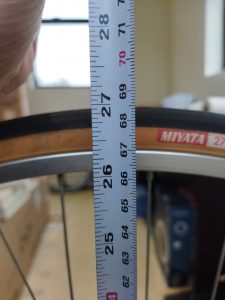
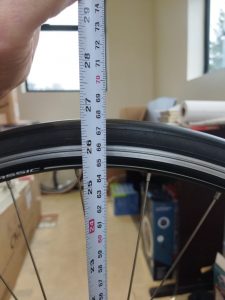
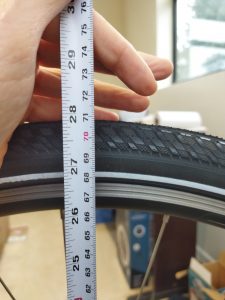
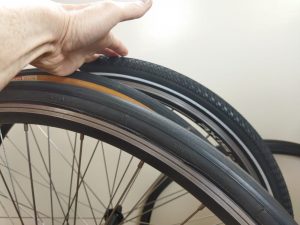
I have a set of 27″ wheels that I got with the Miyata 210 frame.  I will be using them with the Miyata 310 build.  But I am going to use 700c wheels as the primary wheels for the Miyata 310 build since I can use wider tires with the 700c wheels.  Here are some pictures that I took of the 27″ wheels along with two 700c wheels (both having the same type of rim).  The 27″ wheel happens to be almost 27″ tall.  The 700c with the 23c tire is about 1/2″ shorter at roughly 26.5″.  And the the 700c with 38c is roughly an 1″ taller at almost 28″.  There will be plenty of clearance for the wider and taller 700c tires on the Miyata.


My Miyata 210 310 build

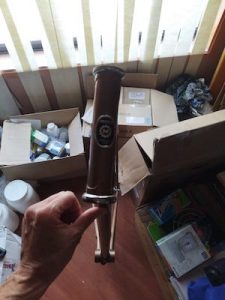
I intended to use a Miyata 210 frame that I got from eBay for a bike build/restoration.  My reason behind a Miyata build, was to pay homage to my first bicycle, a Miyata Sunrise Sport.  But things didn’t go well for my intended Miyata 210 build.  I have been using a freight forwarder in the Miami Florida area to send eBay purchases to me in Chile. When I received the frame in early September, I gave it a quick glance. There was some cardboard around front fork for shipping. But things had come up during that time and I did have the time to really look at the frame. So at the end of December I completely took the frame out of the box and remove the cardboard around the front fork.  There was some cardboard between the fork tips to keep them separated.  I also purchased the original wheels for the frame and started to put the wheels on the frame.  I put the rear wheel on and it seemed fine.  I put the front wheel on and something was seriously wrong.  The fork arms were bent!  I looked at the frame and discovered that not only were the fork arms bent, it seems the frame was bent at the head tube too.


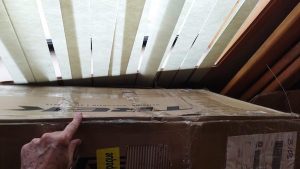
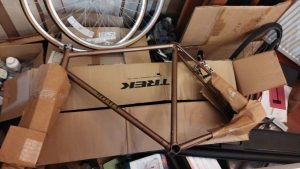
Looking at the packing box, it didn’t look like there was any damage to it.  But it kind of looked pushed in on one side.  But really not that bad.

The fork was installed in the frame and it was turned so the front of the arms were pointing backwards.  It seems that something fell on the front end of the frame where the fork is, causing the fork arms and head tube to bend.  From the original pictures of frame on eBay, everything looked fine.  Looking at the frame now, you can see areas on the fork and the head tube when the paint cracked from when the fork and head tube were bent.  Since it had been too long since I received the frame, I can’t really do anything about it.  I didn’t spend a lot for the frame, but still.  I did contact the freight forwarder but they said they could not do anything about it since I didn’t have it packed in a wooden crate (according to the fine print).  I did have them add extra bubble wrap, but that wasn’t good enough.  I really don’t know if it was damaged when it arrived in Miami or in Chile.  The freight forwarder doesn’t do a good enough job of noticing if items are damaged.  Their customer service was lacking too.  Plus they didn’t consolidate your packages either.  I have since changed to a new freight forwarder that has good customer service and consolidates packages.  Plus I can get insurance on my items shipped to me here in Chile.  So all around a better company.

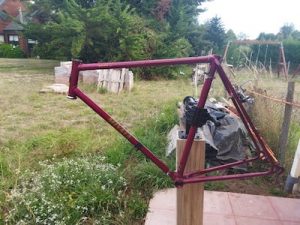
Since I couldn’t use the frame or fork anymore, I went to eBay to see if I could find suitable replacements.  I was able to pick up a Miyata 310 frame, but it didn’t have a front fork.  So I picked up a front fork from eBay too.  It wasn’t from a Miyata, but it is new and fully chromed.  So it will be a nice touch.  This frame also happens to be a 1981 model like the 210 frame.  Both serial numbers start with the letter J which is for the year 1981.  After looking at the frame, I determined that it was ok.  Some minor scratches, but it is in good shape without any bends.

I removed all of the parts from the frame including the headset cups.  Next I will have to remove any stickers.  Can’t sandblast the stickers from the frame.  I also need to remove the Miyata head badge from the frame.

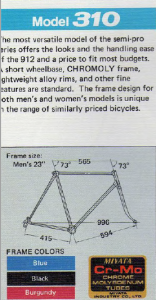
By the way, the 1981 Miyata 310 frames have that geometry of 73 degrees by 73 degrees that I mentioned in my last post.  The color of the frame is Burgundy which is one of the 3 colors available for the 310 in 1981. That’s it for now.


73 degrees by 73 degrees

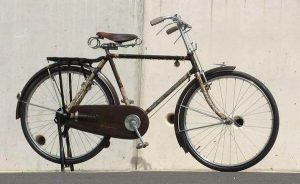
A bicycle geometry of 73 degrees by 73 degrees back in the late 60s and early 70s, could be found on racing bicycles of that era.  But that geometry was entirely appropriate for light (or even medium-load) touring bikes too.  The Fuji S10-S was introduced in 1971 in the US market at the start of the 70’s bike boom.  My introduction to Japanese bicycles was earlier that that.  Back in the late 50’s my family owned a few bicycles that were purchased when we lived in Japan.  The bicycles went with us when we moved back to the US, but eventually they were gotten rid of when we moved again.

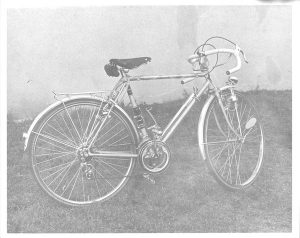
While this is not a picture of one of the bicycles that my family owned, it does have the same characteristics that I remember.  Namely the brakes with metal rods instead of metal cables, the kickstand that lifted the rear wheel, the big chain guard, and the seat with springs.  If I find one of the pictures of the bikes we had, then I will add it.

The first bicycle that I owned was a Miyata Sunrise Sport.  My brother originally purchased the bike in 1967 when we were living in Japan again.  After a few years the bike basically became mine in the spring of 1969.  Here is a picture of the Miyata Sunrise Sport.  A friend of my father called it a Fussa Cadillac.  Fussa was the city that we lived near in Japan.

I rode that bike around for a number of years and fixed things on it as needed.  In the Fall of 1974 I had a well read copy of the Consumers Reports for Bicycles.  There were quite a few bicycles that I liked.  The Fuji Finest was one them.  It was one of Fuji’s road racer models, second to the Fuji Professional.  It was a ten speed and came in two colors, rainbow blue and white.  The Fuji Finest is a great example of the classic Japanese racing bike in the traditional European style.  In 1974, Fuji was ranked first in the Consumers Reports bicycle test.

The Gitane Interclub was another bicycle that I was interested in.  The Fuji Finest was a bit more expensive than the Gitane Interclub.  The Interclub along with the Gran Sport DeLuxe were the bottom level models that Gitane offered during the early 1970s.  Back in September 1975, I purchased a used Gitane Interclub (24″ model) for $100 from a guy who worked at the Proteus bike shop in College Park Maryland.  I was a freshman at the University of Maryland at the time and I rode that bike around the campus a lot that year.  I still had the Interclub back in 2007 but got rid of it when we moved from Georgia.  Side note:  The Proteus Bike Shop used to have a class on frame building.  I never got to sign up for the class since I couldn’t afford it.  The book they have for frame building is available on line as a pdf.  They long since stopped offering that class.

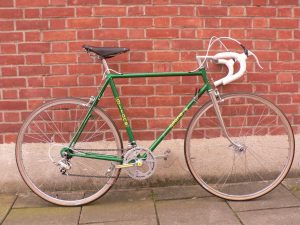
While this is not a picture of the Gitane Interclub I had, it is just like it.  With the green color and chrome front forks.  Later on I painted the frame purple.  Despite using a spray can, it turned out pretty well.

Earlier this year I was looking for a bike that I could ride around the neighborhood with my children.  I hadn’t really found anything that I liked at the bicycle stores, so I started collecting parts on eBay to build a bicycle for myself.  The first thing that caught my attention was the frame for a Miyata 210.  I was partial to Miyatas since I had fond memories of the Sunrise Sport that I had.  Besides, Miyatas were good bikes and made well.  Unfortunately it needed a bottom bracket and a lot of other things.  It is definitely a project bike.  I went ahead and purchased the frame.  I also purchased the two wheels that were originally on it.  We will see how it goes from here.